

Table of Contents
- Why Laser Engraved Pet Memorials Outlast Other Tributes
- Custom Pet Memorial Stones: Granite, Slate, and Other Natural Stone
- Pet Memorial Photo Engraving: Getting the Artwork Right
- Pet Memorial Inscription Ideas: Names, Dates, Epitaphs, and Paw Prints
- Outdoor Pet Memorial Stones: Weather Resistance by Climate
- Shapes, Sizes, and Dimensions: Choosing the Right Marker
- What Drives Cost and How to Order a Custom Memorial
- Conclusion
- Frequently Asked Questions
Last Updated: October 21, 2026
Why Laser Engraved Pet Memorials Outlast Other Tributes
When you buy custom laser engraved pet memorials, you are choosing a marker built to sit outdoors for years. At Gi Laser Art, the mark goes into the stone, not onto it.
Laser engraving is a marking process where a focused beam removes or fuses the top layer of stone to create a permanent design. Because the image is cut into the material rather than printed on top, there is no ink layer to peel, fade, or wash away.
Cheap tributes fail because the marking sits on the surface, where sun, rain, and freeze-thaw cycles attack it from day one.
Laser Engraving vs. Diamond-Impact Engraving
Two methods dominate custom stone work, and they behave differently.
Diamond-impact engraving uses a hardened stylus that strikes the stone thousands of times, chipping away tiny points to form letters and shapes.
Laser engraving vaporizes the surface with a focused beam. On polished black granite it produces crisp contrast and far finer detail, suiting portraits, paw prints, and small text.
Here is the practical split:
| Method | Best For | Detail Level | Outdoor Durability |
|---|---|---|---|
| Laser engraving | Photos, fine text, paw prints | High | Strong on polished stone |
| Diamond-impact engraving | Large lettering, deep marks | Moderate | Very strong |
| Sandblasting with stencil | Classic headstone lettering | Moderate | Very strong |
| Printed or vinyl overlay | Indoor plaques only | High | Poor outdoors |
Custom Pet Memorial Stones: Granite, Slate, and Other Natural Stone
Stone choice decides how your memorial ages. Custom pet memorial stones are usually cut from granite, slate, or sandstone, and each behaves differently in weather.
Black granite is the standard for photo engraving.
Slate offers a softer, matte look with natural cleft edges, suiting garden markers and rustic designs.
Sandstone and limestone carve beautifully but are porous, weathering faster and better suited to sheltered placements than open exposure.
Matching Stone Thickness to Placement
Thickness is the spec buyers skip, and it is the one that decides whether a marker survives.
- Garden markers laid flat in soil: choose a thicker slab so frost heave does not crack it.
- Upright monuments on a base: the base carries the load, so the face can be thinner.
- Wall-mounted plaques: thickness matters less than the fixing method.
A common mistake is buying a thin, wide slab for a lawn setting. Wide and thin is the worst combination for frost. Narrow and thick survives.
Pet Memorial Photo Engraving: Getting the Artwork Right
Photo quality decides the final result more than any machine setting. Pet memorial photo engraving transfers your image one-to-one, so every flaw in the source shows up in the stone.
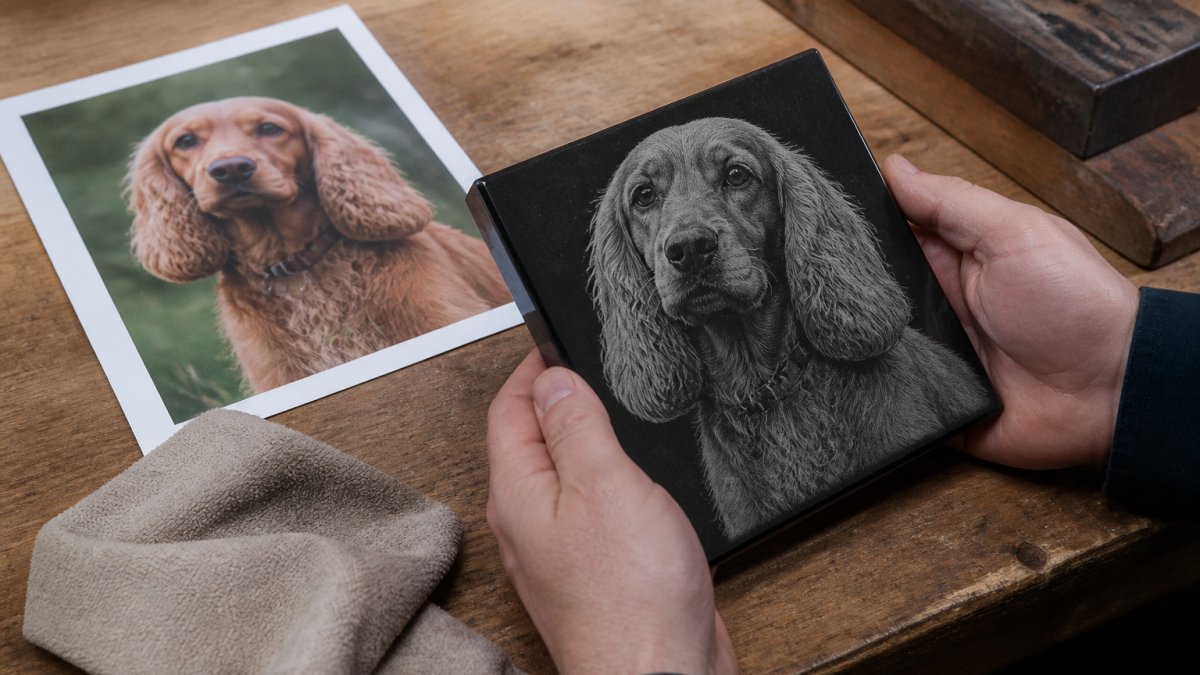
What makes a good source photo:
- Sharp focus on the face, especially the eyes
- Even lighting without a harsh flash
- A plain or uncluttered background
Send the original file if you have it; a phone photo taken today usually beats a scanned print from years ago. If your only photo is soft or low-resolution, tell the engraver up front.
Pet Memorial Inscription Ideas: Names, Dates, Epitaphs, and Paw Prints
Pet memorial inscription ideas work best when they stay short, personal, and readable at a glance.
A strong inscription carries four elements: the pet's name, the dates, a short epitaph, and one personal detail, a favorite toy, a nickname, a line the family always said. That last part separates a generic marker from a real tribute.
Practical rules for layout:
- Keep the name largest and centered
- Use dates in a consistent format
- Limit the epitaph to a few lines so lettering stays legible
Sample Epitaphs for Dogs and Cats
Short lines engrave cleanly and read well at a distance:
- "Always at the door, always in our hearts."
- "Good dog. Best friend."
- "She never met a stranger."
For a longer tribute, a full paragraph can work on a larger upright monument, but small garden markers need brevity. Fewer words, larger letters, better readability.
Outdoor Pet Memorial Stones: Weather Resistance by Climate
Outdoor pet memorial stones fail for predictable reasons, and climate tells you which risk matters most.
In cold regions, water seeps into porous stone, freezes, expands, and flakes the surface; dense, polished granite handles this best. In hot climates, UV attacks any applied coating or print, which is why engraved marks outlast printed ones.
Placement matters as much as material:
- Keep markers off sprinkler lines and out of standing water
- Avoid full-day direct sun on dark stone in extreme heat
- Set lawn markers on a gravel base for drainage
A periodic rinse with clean water and a soft brush keeps most outdoor memorials looking right. Skip acidic cleaners, which dull polished surfaces.
Shapes, Sizes, and Dimensions: Choosing the Right Marker
Shape should follow placement. A heart-shaped marker suits a garden bed, an upright monument suits a gravesite, and a small plaque suits a shelf. The mistake buyers make is choosing a shape first and then discovering the epitaph will not fit.
| Shape | Typical Use | Typical Face Size | Notes |
|---|---|---|---|
| Heart-shaped marker | Garden tribute, indoor display | Roughly 6-10 in. wide | Warm look, limited space for text |
| Upright monument | Gravesite, permanent setting | Roughly 12-24 in. wide face | Needs a base, most room for engraving |
| Flat garden marker | Lawn or flower bed | Roughly 8-16 in. wide | Sits low, easy to mow around |
| Wall plaque | Porch, shed, memorial wall | Roughly 5-12 in. wide | Fixing method matters most |
| Cremation marker | Urn companion, indoor keepsake | Roughly 4-8 in. wide | Compact, often paired with a photo |
Those ranges are starting points, not standards. The right size gives each element room at the distance it will be viewed from.
Sizing Backward From the Engraving
Work backward from the content: decide the photo, name, dates, and epitaph first, then pick dimensions that give each element room.
- Name. The largest element. On a garden marker viewed from a few feet away, plan on the name taking the top third of the face.
- Dates. Smaller than the name, set in one consistent format. Two lines of dates take less width than a single long line.
- Epitaph. A short line or two fits a small marker. A full paragraph needs an upright monument face.
A useful rule of thumb: if the proof looks crowded at actual size, the stone is too small for the content. Order the next size up or cut words, not letter size.
Thickness and Placement
Thickness is the spec buyers skip, and it is the one that decides whether a marker survives.
- Garden markers laid flat in soil: choose a thicker slab so frost heave does not crack it.
- Upright monuments on a base: the base carries the load, so the face can be thinner.
- Wall-mounted plaques: thickness matters less than the fixing method.
A common mistake is buying a thin, wide slab for a lawn setting. Wide and thin is the worst combination for frost. Narrow and thick survives. Measure the space before you order, and confirm any cemetery or property rules on marker dimensions before the stone is cut.
What Drives Cost and How to Order a Custom Memorial
Cost comes down to five variables: stone type, size and thickness, engraving complexity, photo engraving, and shipping or base options.
Here is how each factor moves the number:
- Stone type. Polished black granite costs more per square inch than slate or sandstone because it is denser, takes a finer polish, and reliably holds photographic contrast. It is the smallest swing on a photo piece and the largest on a text-only garden marker.
- Size and thickness. Price scales with surface area more than thickness, but thick slabs add weight and shipping cost. A wide, thin slab is cheaper to cut and more expensive to replace after a frost crack.
- Engraving complexity. Straight text is cheapest. Fine line art, paw prints, and small epitaphs add machine time. A full photographic portrait costs most because it requires tonal mapping and often a second pass.
To compare quotes, ask each engraver to price the same three configurations, a small text-only garden marker, a mid-size plaque with a paw print and dates, and a full photo portrait on polished granite. That gives you a real cost curve instead of a single number.
A Transparent Ordering Walkthrough
- Choose the stone and shape. Match it to indoor or outdoor placement first; a garden heart and a gravesite upright have different base and shipping implications.
- Measure your space. Note the width and depth available, whether the marker sits flat or upright, and whether the setting is irrigated. Send those dimensions with your order.
- Send your photo and wording. Original files, spelled exactly as you want them, with the pet's name, dates in one consistent format, and the epitaph as you intend it to read.
- Approve the proof. Check layout, spelling, portrait crop, and letter size at actual scale. Ask for a PDF sized to the stone so you can judge readability.
- Confirm the quote and timeline. Ask about production lead time and holiday cutoffs early; photo engraving adds days, not hours.
- Receive and place. Follow the drainage and fixing guidance for your setting, and inspect the piece before it goes outside.
Installation, Placement, and Long-Term Care
Set flat markers on a compacted gravel base so water drains away. Seat upright monuments on a level foundation and check them after the first freeze. For wall plaques, use fixings rated for the substrate.
Care is simple: water, a soft brush, and patience. Avoid pressure washing polished granite at close range, and never scrub engraved areas with an abrasive pad.
Conclusion
Choosing a memorial for a pet is hard enough without wondering whether the stone will still look right in five years. Material, engraving method, and artwork quality decide that far more than the price tag. Gi Laser Art engraves custom pet memorials on natural stone with the same care we put into every keepsake, and as a veteran-owned business, a portion of our proceeds supports service dogs for fellow veterans.
Frequently Asked Questions
What can you put on a custom pet memorial?
Most laser engraved pet memorials include the pet's name, birth and passing dates, and a short epitaph. You can add a laser-etched portrait from a photo, paw prints, a breed silhouette, or a favorite quote. Granite and slate hold fine detail well, so small text and line art stay readable. Keep the layout uncluttered: a name, two dates, one image, and one or two lines of text is usually enough, and it reads clearly from a few feet away.
Are laser engraved pet memorials suitable for outdoor use?
Yes, when the stone and the engraving method match the placement. Polished granite with laser engraving holds up through freeze-thaw cycles, rain, and direct sun. Outdoor pet memorial stones in slate work well in sheltered garden spots but are more porous, so they benefit from a sealer. Avoid soft stones and thin plaques in exposed areas. Set the marker on a level base so water drains away rather than pooling against the face.
Can a pet memorial stone be personalized with a photo?
Photo engraving is one of the most requested options. Send the sharpest original file you have, not a screenshot or a photo of a photo. A head-on shot with even lighting and a plain background produces the cleanest etched portrait. Tell the seller which details matter most, such as the eyes or a marking on the chest, so they can adjust contrast. Expect to approve a proof before the stone is engraved.
What materials are best for an engraved pet memorial?
Black granite is the most durable choice for an outdoor memorial because it is dense, absorbs little water, and holds laser engraving with strong contrast. Gray and colored granites also work well. Slate offers a softer, rustic look for garden markers and sheltered placements. Marble looks classic but stains and etches faster outdoors. Ask what stone thickness the seller uses, since thin blanks crack in frost.
How do you choose the right size for a pet memorial plaque?
Match the size to the space and the amount of text. A garden marker around 6 by 4 inches fits a name, dates, and a short line. Upright monuments and larger stones, roughly 12 by 8 inches and up, suit a photo portrait plus a longer epitaph. Measure the spot first, leave room for the base, and remember that text shrinks visually at a distance. Larger stones are also heavier, so plan how you will move it.
How do you care for a laser-engraved pet memorial?
Wipe the surface with a soft damp cloth and mild soap, then dry it. Skip abrasive pads, bleach, and acidic cleaners, which dull polished granite and can wear the etched areas. Rinse away bird droppings and tree sap promptly. In cold climates, avoid scraping ice with metal tools. If the stone sits under trees or near sprinklers, a yearly rinse keeps mineral deposits from clouding the engraving.