

Last Updated: October 28, 2026
Quick Summary
A wooden desk name plate is a small block of wood with text cut or burned into its surface, placed on a desk to show a name, title, or role. Gi Laser Art makes custom engraved wood signs and name plates to order, with pricing based on size, material, and design.
- Walnut and mahogany suit executive offices; oak suits classrooms because it tolerates handling.
- Dark woods like walnut need a contrast method such as light fill, metal inlay, or carving.
- Ask to see the actual blank or a proof on the specific wood before engraving.
- Print your layout at actual size and read it from a visitor's distance before approving.
- For matched sets, ask for all blanks to be cut from the same board and finished together.
Table of Contents
- Engraved Wooden Desk Name Plate Basics: What You Are Actually Buying
- Solid Walnut Desk Name Plate vs Oak, Acacia and Cherry: Wood Species Compared
- Wood and Brass Desk Name Plate Options and When Metal Accents Make Sense
- Engraving Methods, Fonts and Legibility: How Your Text Will Look
- Wooden Desk Name Plate Size Guide: Matching Dimensions to Your Desk
- Engraved Office Name Plate with Logo: Adding Branding, Seals and Rank
- Ordering a Custom Desk Name Plate: Proofing, Timing and Care from Gi Laser Art
- Frequently Asked Questions
Engraved Wooden Desk Name Plate Basics: What You Are Actually Buying
An engraved wooden desk name plate is a small block of wood with text cut or burned into its surface, placed on a desk to show a name, title, or role. At Gi Laser Art, custom engraved wood signs and name plates are made to order, with pricing based on size, material, and design.

Before ordering, decide what the plate needs to do: a reception desk visitors see daily, a home office only you read, or a gift for a retiring colleague.
Here is a quick way to narrow your options:
| Use Case | Recommended Wood | Typical Text | Finish |
|---|---|---|---|
| Executive office | Walnut | Name and title | Polished or satin |
| Classroom or teacher desk | Oak | Name, subject | Satin |
| Gift for a colleague | Cherry | Name and short message | Polished |
| Reception desk | Walnut or oak | Name, department | Satin |
Solid Walnut Desk Name Plate vs Oak, Acacia and Cherry: Wood Species Compared
Wood choice drives three things buyers notice: how the plate looks, how well the lettering reads, and how it holds up over years. Here is how walnut, oak, acacia, cherry, and mahogany compare.
Appearance and grain, species by species
Walnut is a dark chocolate-brown hardwood with a tight, straight-to-slightly-wavy grain. It reads as formal and executive and hides dust and fingerprints better than lighter woods. Because the base is dark, engraving needs a contrast strategy (light fill, metal inlay, or a shallow burn that catches light).
Oak is light tan to medium brown with a pronounced, open grain, visible pores appear as short dark dashes. That open grain is the trade-off: warm and traditional, but small letterforms can get broken up by the pores. It is the most forgiving species for a classroom or teacher desk.
Acacia ranges from golden to reddish-brown with a dramatic, swirling, high-contrast grain. No two blanks look alike, the appeal for a modern office and the risk for a matched set. Ask whether blanks will be cut from the same board if consistency matters.
Cherry starts light pinkish-brown and darkens to deep reddish-brown over months of light exposure. That aging makes it popular for retirement gifts and traditional offices, but the plate will not match what you see two years later.
Mahogany is a reddish-brown hardwood with a fine, uniform grain and natural luster. It sits between walnut and cherry in tone and is most associated with traditional plaques and legal or financial offices. Genuine mahogany is a premium tier; some products labeled mahogany are a different species, so confirm what you are buying.
Side-by-side comparison
| Wood | Color range | Grain character | Relative cost tier | Engraving contrast | Best fit |
|---|---|---|---|---|---|
| Walnut | Dark brown | Tight, subtle | Mid to upper | Needs light fill or inlay | Executive office, formal reception |
| Oak | Light to medium tan | Open, prominent pores | Entry to mid | Good with larger, bolder text | Classroom, traditional decor |
| Acacia | Golden to reddish | Dramatic, swirling, variable | Mid | Variable, depends on the blank | Modern office, one-off pieces |
| Cherry | Light, darkens to reddish-brown | Smooth, fine | Mid to upper | Good with fine text | Gifts, warm traditional settings |
| Mahogany | Reddish-brown | Fine, uniform, lustrous | Upper | Strong with light fill | Legal, financial, formal plaques |
Durability and how each species wears
Density is the practical durability measure. Walnut, oak, cherry, and mahogany are dense hardwoods that resist dents from keys, mugs, and knocks. Acacia is also dense but varies more from blank to blank. Softer woods, pine, basswood, and "wood-look" composites, dent and scratch faster and are a false economy for a working desk.
Two wear factors matter more than species: finish and environment. Oil is easy to refresh but protects less against spills; lacquer or polyurethane resists moisture better but can chip at the edges. Direct sun fades a plate and darkens cherry unevenly, and a spot near a kitchenette or rainy window shows water rings regardless of species.
How each wood takes an engraving
- Laser engraving burns the surface. On light woods like oak and cherry the mark is dark and reads clearly; on walnut and mahogany the burn is closer in tone, so contrast is weak unless deeper, filled, or paired with a light inlay.
- Hand carving cuts a groove that catches light and shadow, reading well on walnut and mahogany without fill. On open-grain oak, carving can follow the pores and look rougher than intended.
- Color fill works on any species but is most useful on dark woods, where a light fill supplies contrast the burn cannot.
- Metal inlay (brass or similar) gives the strongest contrast on walnut and mahogany and is the most expensive option.
A useful rule: the darker the wood, the more you should budget for a contrast method, fill, inlay, or carving, rather than relying on a plain laser burn.
Choosing by use case
- Executive office or formal reception: walnut or mahogany with a light fill or brass inlay.
- Classroom or teacher desk: oak with bold, larger lettering; it tolerates handling and reads well in fluorescent light.
- Retirement or colleague gift: cherry, ideally with a short message; the aging color is part of the gift.
- Modern office or creative studio: acacia for a one-off piece; confirm blank consistency if ordering a set.
- Legal, financial, or government-style office: mahogany or walnut, with a formal serif and a metal accent if budget allows.
Watch out: A photo of a finished plate is not a reliable guide to the blank you will receive. Ask to see the actual blank or a proof on the specific piece before engraving.
Wood and Brass Desk Name Plate Options and When Metal Accents Make Sense
A black and gold plate, for example, pairs dark wood with gold-toned lettering or trim. These look polished and suit executive offices, law firms, and reception areas.
Custom Engraved Wood Signs & Name Plates →
Engraving Methods, Fonts and Legibility: How Your Text Will Look
Legibility on a wooden name plate is the interaction of four variables: engraving method, the wood's color and grain, the font, and viewing distance.
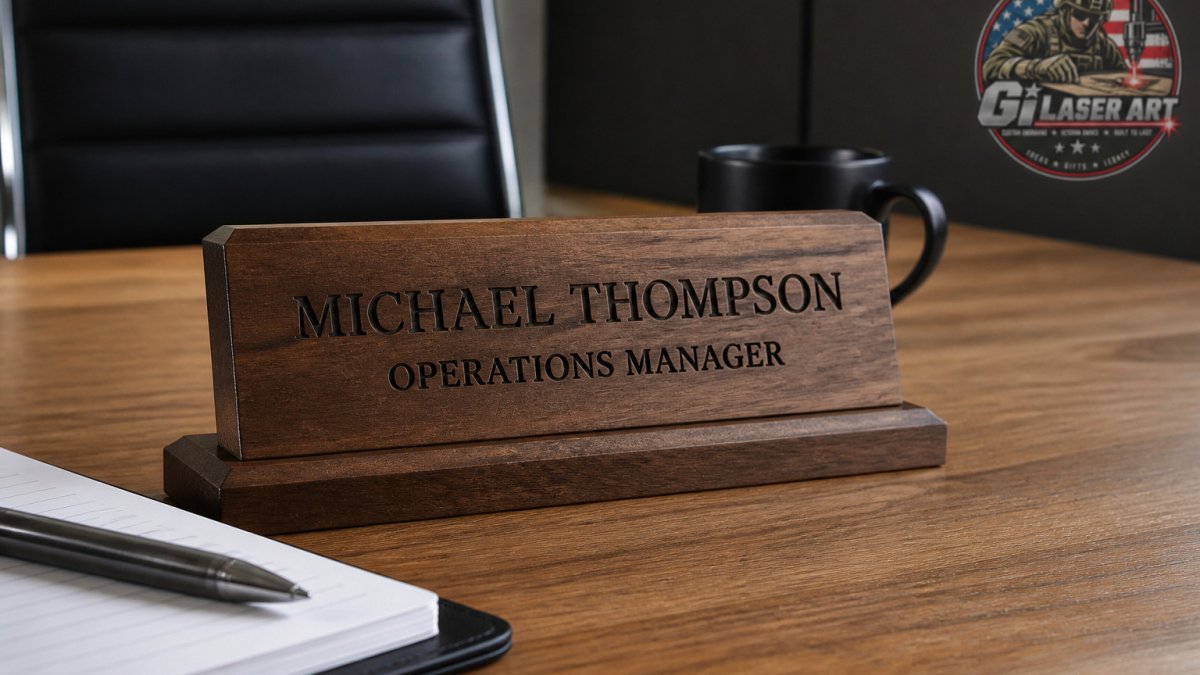
The three engraving methods compared
Laser engraving uses a focused beam to burn the surface. It is the most common method for custom wooden name plates because it is precise, repeatable, and handles fine fonts and small logos. The burn is clearly darker on light oak and cherry, close in tone on dark walnut and mahogany unless deeper, filled, or inlaid. It is also the most consistent method for matched sets.
Hand carving cuts a groove with a chisel or rotary tool. The cut catches light and shadow, giving strong contrast on dark woods without fill, a carved walnut plate reads clearly even though wood and recess are the same color. Trade-offs: cost, consistency (hand work varies piece to piece), and detail limits (very fine strokes and small logos are difficult).
Engraved metal inserts set a brass or similar plate into a recess in the wood, with text engraved or printed on the metal. This gives the highest contrast and durability of any method. Trade-offs: cost, visual weight, and the risk of loosening over time if the recess is not cut precisely.
| Method | How it marks | Contrast on light wood | Contrast on dark wood | Detail limit | Relative cost |
|---|---|---|---|---|---|
| Laser engraving | Burned surface | Strong | Weak without fill | Very fine | Low to mid |
| Hand carving | Cut groove | Moderate | Strong via shadow | Moderate | Mid to high |
| Metal insert | Engraved metal plate | Strong | Strong | Fine | High |
How wood grain affects legibility
Color contrast follows a simple rule: dark text on a light base or light text on a dark base. Laser engraving naturally produces dark-on-light, which is why it works on oak and cherry. On walnut and mahogany the burn is only slightly darker than the base, so a light color fill or metal insert restores contrast. Carving sidesteps color by using shadow instead of pigment.
Font choice and viewing distance
A useful test: print your proposed layout at actual size, place it on the desk where the plate will sit, and read it from the distance a visitor would. If you struggle, the text is too small, too thin, or too busy for the wood you chose.
Color fill: when it helps and when it hurts
Color fill presses pigment into the engraved recess. It helps most on dark woods, where a light fill gives contrast the burn cannot, and least on light woods with laser engraving, where the burn already reads clearly. Fill adds a failure mode: pigment can wear out of the recess over years of cleaning, leaving patchy lettering. If you choose fill, ask what type is used and whether it is sealed under the finish.
Proofing workflow before production
Most legibility problems trace back to skipping step 4. A proof on the right wood, at the right size, viewed from the right distance, prevents nearly every "it looked better on screen" outcome.
Wooden Desk Name Plate Size Guide: Matching Dimensions to Your Desk
Before ordering, sketch the plate's footprint on paper and place it on your desk, this prevents most sizing mistakes. A two-line name and title needs more height than a single name, so match the layout to the size.
Engraved Office Name Plate with Logo: Adding Branding, Seals and Rank
For a team order, use the same layout on each plate so the set looks consistent, and ask for a single proof showing all the plates together before approving.
Ordering a Custom Desk Name Plate: Proofing, Timing and Care from Gi Laser Art
Send your details through the custom quote process. At Gi Laser Art, our custom engraved wood signs and name plates are made to order, with pricing based on size, material, and design. Click Request a Custom Quote and describe what you want, including names, wording, design ideas, or a logo. Pricing and shipping are agreed before any payment is requested, and submitting a quote request does not require payment.
Frequently Asked Questions
What wood is best for an engraved desk name plate?
Solid walnut is the most popular choice for a professional desk because its dark, even grain gives engraved text strong contrast and a formal look. Oak is a lighter, harder option that suits brighter offices, while cherry develops a warmer tone over time. Acacia offers a distinctive grain at a lower price point. Choose based on your office décor and how much contrast you need for the lettering.
How do you personalize a wooden desk name plate?
Submit your names, wording, design ideas, or other details through the Request a Custom Quote option on the custom engraved wood signs and name plates page. If you have a logo or image you’d like included, mention it in your request, and the business will contact you to discuss the artwork. Details, pricing, and shipping costs are agreed before payment is requested.
What size should a desk name plate be?
A typical wooden desk name plate fits comfortably within a standard desk surface, but measure the front edge of your desk and the depth where the plate will sit before ordering. Longer plates suit multi-line titles, while shorter plates work for a name alone. Confirm dimensions with the custom quote, since sizing is set by the material and design you request.
Can you engrave a logo on a wooden desk name plate?
If you have a logo or image you’d like included, mention it in your quote request, and the business will contact you to discuss the artwork.
