

Last Updated: October 26, 2026
Quick Summary
Handmade personalized gifts are produced one at a time with human handling at key steps, so fine detail, custom artwork and unusual sizes hold up better, while factory-made gifts run through automated, high-volume processes where personalization is a small add-on. The proof step is the real differentiator: made-to-order shops typically send a preview for approval before production begins.
- Factory personalization is a template with a text field, so fixed geometry and limited materials cap what it can do.
- A made-to-order piece carries setup, design review, proofing and hand finishing costs on a single order.
- Lead time is production time plus proofing turnaround plus shipping, and proof approval is part of the timeline.
- Ask whether the proof step is preserved before paying a rush fee to buy calendar time.
- For a close relationship and milestone occasion, go made-to-order with a design conversation.
Table of Contents
- Why Handmade Gifts Feel Different to the Person Receiving Them
- Handmade vs Factory Made Personalized Gifts: The Core Differences
- Customization Limits: What Each Method Can and Cannot Personalize
- Cost, Lead Time, and Ordering Deadlines Compared
- How to Choose a Personalized Gift for the Recipient and Occasion
- Custom Engraved Gifts: Where Proofing and Quality Control Decide the Outcome
- Personalized Wedding Gifts: A Case Study in Handmade vs Factory Made
- Order a Custom Piece from Gi Laser Art
- Frequently Asked Questions
Why Handmade Gifts Feel Different to the Person Receiving Them
A gift made by hand carries the visible trace of its maker, and that trace changes how the recipient reads the object.
At Gi Laser Art, we work in that middle ground every day: pieces laser cut and hand assembled to order, engraved with names, breeds, and messages a mass-produced item cannot accommodate.
Below, we break down how the two methods differ, where personalization breaks down on each side, and how to choose well without overspending or missing a deadline.
Handmade vs Factory Made Personalized Gifts: The Core Differences
Handmade personalized gifts are produced one at a time with human handling at key steps; factory-made gifts run through automated, high-volume processes where personalization is a small add-on.
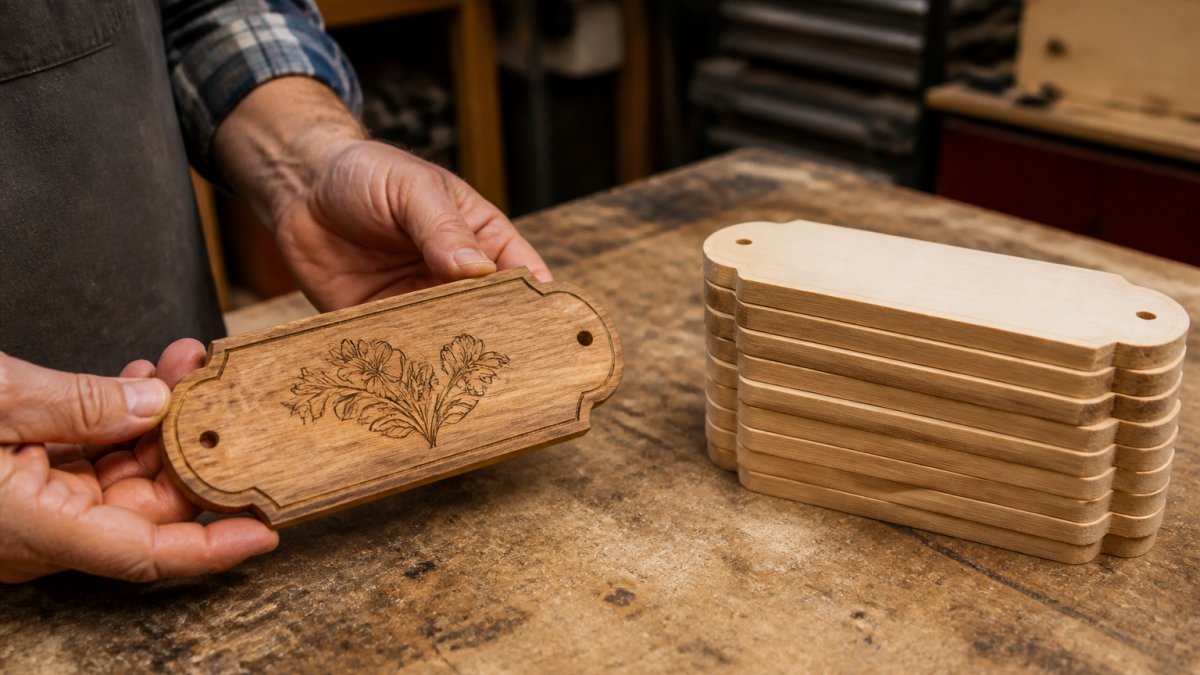
Production Methods and What They Mean for Detail
In a small shop, someone checks the artwork before it runs, catches a misspelled name, and adjusts engraving depth or layout. In mass production, personalization is a template with a text field, and nobody inspects the individual unit unless something triggers a flag.
That gap shows up in fine detail. Curves, serif lettering, small logos, and layered designs hold up better when a person is watching the output. Templates handle simple names well and struggle with anything custom.
Materials, Durability, and Long-Term Care
Material choice is where factory gifts quietly cut corners. Thin laminates, coated plastics, and printed surfaces look sharp on day one and wear within a year; solid wood, natural slate, and properly finished surfaces age instead of degrading.
Care follows the material. Wood and slate want a dry cloth and mild soap, not a soaking. A protective coating on slate makes routine cleaning easier and helps the engraving stay legible.
Customization Limits: What Each Method Can and Cannot Personalize
The table below is the short answer. The longer answer is why each method has the limits it does: personalization is not a feature you bolt on but a constraint set by how the item is produced.
| Capability | Factory-Made | Made-to-Order Handmade |
|---|---|---|
| Names, dates, short text | Reliable | Reliable |
| Logos and custom artwork | Limited or unavailable | Usually workable |
| Layered or multi-material designs | Rare | Common |
| Unusual sizes or shapes | Fixed catalog only | Often possible |
| Design help for non-designers | None | Standard |
| Proof before production | Sometimes | Typically |
Why Factory Personalization Stops Where It Does
Factory personalization is a template with a text field: the design is fixed, only the variable data changes. That architecture makes it cheap and fast, and also brittle.
- Fixed geometry. The template assumes a specific size, shape, and layout. An unusual size or a logo with fine detail does not fit the template, so it is rejected or rasterized into something coarser.
- No design judgment. Nobody looks at your artwork and decides how to adapt it. If the file does not match the template's expectations, the order is either canceled or produced as-is.
- Limited materials. Factory lines are set up for specific substrates, coated plastics, laminates, standard woods. A request for a different material means retooling, which a high-volume line will not do for one order.
This is not a knock on factory production, it is the correct trade-off for shipping thousands of identical items. The limit is structural, not a failure of effort.
Why Made-to-Order Handles the Hard Requests
A small shop substitutes human judgment for the template: someone looks at your rough idea, decides how it will engrave on the chosen material, and adjusts the layout before production. That is why logos, layered designs, and unusual sizes are workable.
The limit on this side is capacity, not capability. A maker can do the hard request, but only for a limited number of orders at a time.
The Proof Step Is the Real Differentiator
The last row of the table matters most. A factory template gives you a text box and no preview; a made-to-order shop typically sends a proof, a preview of the final artwork and layout, for approval before production begins.
The proof is where personalization quality is actually decided. It is your only chance to catch a swapped letter, a logo in the wrong spot, or artwork that will not engrave cleanly on the chosen material. Ask three questions before you approve:
- Is the spelling exactly right, including capitalization?
- Is the layout centered and sized as you expect?
- Does the artwork match the material's limits?
How to Judge a Shop's Real Personalization Capacity
Before you order, ask what the shop can and cannot do on your specific material. A maker who tells you a design will not engrave cleanly is more trustworthy than one who says yes to everything. If your request falls outside standard options, you can request a fully custom piece and describe what you have in mind before any payment is involved.
Cost, Lead Time, and Ordering Deadlines Compared
Most comparisons stop at "factory is cheaper and faster." True at the unit level, but not useful for a purchase decision. What buyers need is a working model of where the money and the calendar go once personalization enters the order.
Where the Money Actually Goes
A factory-made personalized gift is cheap per unit because fixed costs, tooling, templates, setup, spread across thousands of units, and personalization is a small marginal add-on: a text field merged into a print or engrave file.
A made-to-order piece carries the same fixed costs spread across one unit: setup, design review, proofing, material selection, and hand finishing all land on a single order.
A quote that separates base, personalization, and rush fees tells you what you are actually paying for; a single bundled number does not.
The Real Cost of a Mistake
The unit price is only half the cost story. The other half is what happens when a personalized item arrives wrong.
A factory order with a misspelled name triggers a return-and-reorder cycle: ship it back, wait for processing, hope the replacement arrives in time.
Custom Engraved Wood Signs & Name Plates →
Run the math on a single order: base price plus rush shipping plus the value of your time spent on the return.
Lead Time: The Constraint Buyers Underestimate
Lead time is not one number: it is production time plus proofing turnaround plus shipping, and each piece behaves differently by method.
- Factory-made: production is fast because the item is already in a catalog; personalization adds a short step. The bottleneck is usually shipping and order volume, not manufacturing.
- Made-to-order: production time depends on the shop's queue and the complexity of your design. Proofing adds a round trip, you review, you approve, production starts. That round trip is where deadlines are won or lost.
A practical rule: the deadline that matters is the order cutoff, not the shipping estimate. Around the holidays, made-to-order shops fill up and cutoffs move earlier than buyers expect. Confirm the production window in writing, and treat proof approval as part of the timeline.
Rush Orders and What They Really Cost
Rush availability differs by method. A factory can often expedite shipping because the item exists, but not always personalization if the queue is full.
A common pattern is that rush fees buy calendar time, not quality time. If you pay for a rush, ask explicitly whether the proof step is preserved.
For a detailed breakdown of turnaround, read our guide on how long custom engraving takes.
How to Choose a Personalized Gift for the Recipient and Occasion
Match the gift to the relationship first, then the occasion, then your budget. A coworker gets a clean engraved item with a name or milestone date; a close family member can carry something more personal, like an inside joke or a pet's breed; a wedding or anniversary calls for something the couple will display, not store in a drawer.
Use this quick decision framework:
- Close relationship, milestone occasion: go made-to-order with a design conversation.
- Professional relationship: choose a clean, simple engraved piece with a name or logo.
- Large group or bulk order: confirm capacity and per-unit timing before you commit.
- Tight deadline: pick a simpler design and order immediately.
- Unsure of taste: choose a functional item like coasters or a sign over pure decor.
A common mistake is choosing the most elaborate design available rather than the one the recipient will actually use. Thoughtfulness beats complexity every time.
Custom Engraved Gifts: Where Proofing and Quality Control Decide the Outcome
For custom engraved gifts, the proof is the whole ballgame. A proof is a preview of the final artwork and layout sent for your approval before production.
Watch out: skipping the proof to save a day is the single most common way a personalized order goes wrong, and the fix usually costs more time than the proof would have.
Ask three questions before you approve anything:
- Is the spelling exactly right, including capitalization?
- Is the layout centered and sized as you expect?
- Does the artwork match the material's limits?
A shop that welcomes proofing questions and revises without friction is telling you something about how it handles errors. If you want a walkthrough of the full process, see how to order custom engraved name plates online.
Personalized Wedding Gifts: A Case Study in Handmade vs Factory Made
Personalized wedding gifts are the clearest test case, because the stakes are high and the couple notices everything.
The pattern we see repeatedly: couples receive plenty of identical registry items and remember the handful of pieces that were clearly made for them.
If you are shopping for a couple right now, our collection of personalized wedding gift ideas covers options by style and budget.
Order a Custom Piece from Gi Laser Art
Most personalized gifts are personalized in name only. A name dropped into a template is not the same as a piece designed for one person, and recipients feel the difference immediately.
Gi Laser Art is a veteran-owned shop that makes custom laser-engraved keepsakes to order, using materials like wood and slate, with a portion of proceeds supporting service dogs for veterans. Browse our personalized gifts collection to find the right piece, or send us your idea and we will work through the design with you before you pay a cent.
Frequently Asked Questions
Are handmade personalized gifts better than factory-made gifts?
Neither is universally better. Handmade personalized gifts usually offer deeper customization, more durable materials, and a one-of-a-kind character, but they cost more and take longer to produce. Factory-made gifts win on speed and low price, yet designs are often limited to preset templates and identical products. Match the choice to your recipient, budget, and deadline rather than assuming one method is always superior.
Which type of personalized gift offers more customization?
Handmade and made-to-order pieces generally allow more customization. A maker can adjust wording, layout, size, and material, and can work from a logo, photo, or rough idea. Factory-made personalized gifts typically rely on fixed templates with limited text fields. If you need something unusual, such as a custom engraved gift with a specific design, ask the maker directly before ordering.
Do handmade personalized gifts take longer to make?
Yes, usually. Made-to-order work involves design proofing, production, and finishing, so lead times stretch beyond same-day shipping. Factory-made items ship quickly because they come off an existing line. Order handmade pieces well ahead of holidays and weddings, and confirm the production window in writing. Gi Laser Art, for example, agrees on all design details and pricing before payment is requested.
How can you tell if a personalized gift is well made?
Look at the engraving or printing depth, edge finish, material quality, and whether the personalization is centered and legible. Ask about durability, care instructions, and what happens if the result does not match the proof. A maker who sends a proof before production and offers a clear redo policy is a strong signal of quality control. On natural materials like wood and slate, slight grain variation is normal and expected.
The difference between a forgettable gift and a kept one usually comes down to a proof, a material choice, and a maker who was paying attention. Get started with Gi Laser Art and give something the recipient will still have on display years from now.
