

Last Updated: November 2, 2026
Quick Summary
To verify charity donation transparency, check the charity's own published documents first, then confirm its 501(c)(3) status through the IRS Tax Exempt Organization Search and read its Form 990. You can also check state registration and complaint records, and ask the charity direct questions in writing before you give.
- Confirm the charity's status shows as exempt and active in the IRS Tax Exempt Organization Search before claiming a deduction.
- Compare three years of Form 990 figures side by side, since a single bad year can be a timing issue.
- Read Part VII and Schedule L together to spot board relationships and conflicts of interest.
- Ask what share of your donation funds programs versus overhead, and request the answers in writing.
- Pay by card or check and keep a written receipt, since cash and gift cards are hard to trace.
Table of Contents
- Start With the Charity's Own Paper Trail
- How to Verify a 501(c)(3) Organization Through the IRS
- Run a Nonprofit Form 990 Lookup and Read What You Find
- Check State Registration and Complaint Records
- What Charity Ratings and Watchdogs Can and Cannot Tell You
- Questions to Ask a Charity Before Donating
- Trace Your Donation From Payment to Program Outcome
- Confirm a Veteran-Owned Shop's Giving Claim Before You Buy
- Frequently Asked Questions
Start With the Charity's Own Paper Trail
Learning how to verify charity donation transparency starts with the simplest step: reading what the organization already publishes.
"How do I know my money is actually going there?" is the right question to ask any organization, including ours.
Charity donation transparency means an organization openly shows where money comes from, where it goes, and who decides. It is a set of documents you can check, not a feeling you get from a good story.
Start with these basics on the charity's own website:
- A legal name and physical address, not just a PO box
- An Employer Identification Number (EIN)
- A board of directors listed by name
- Recent annual reports and financial statements
- A clear statement of mission and programs
If any of these are missing, that is your first red flag. Many charities post them freely. The IRS guide to tax-exempt organizations explains what a legitimate organization should be able to provide.
How to Verify a 501(c)(3) Organization Through the IRS
You can verify a 501(c)(3) organization in minutes using the IRS Tax Exempt Organization Search. The tool confirms whether a group holds federal tax-exempt status and whether donations to it are tax-deductible.
Here is the process:
- Go to the IRS Tax Exempt Organization Search page.
- Search by the charity's EIN or exact legal name.
- Confirm the status shows as exempt and active.
- Check the "deductibility" field before you claim a write-off.
This step matters. Some groups use "nonprofit" loosely, but only a genuine 501(c)(3) lets you deduct donations. A group that has lost its status may still be collecting money.
Watch out: a revoked or "not listed" result does not always mean fraud. Small groups sometimes fall behind on filings. But until the status is restored, treat the donation as a gift, not a deduction. The IRS Tax Exempt Organization Search is the only official source for this check.
Run a Nonprofit Form 990 Lookup and Read What You Find
A nonprofit Form 990 lookup shows you the organization's yearly tax return, which is public record. Form 990 reports revenue, expenses, salaries, and program spending.
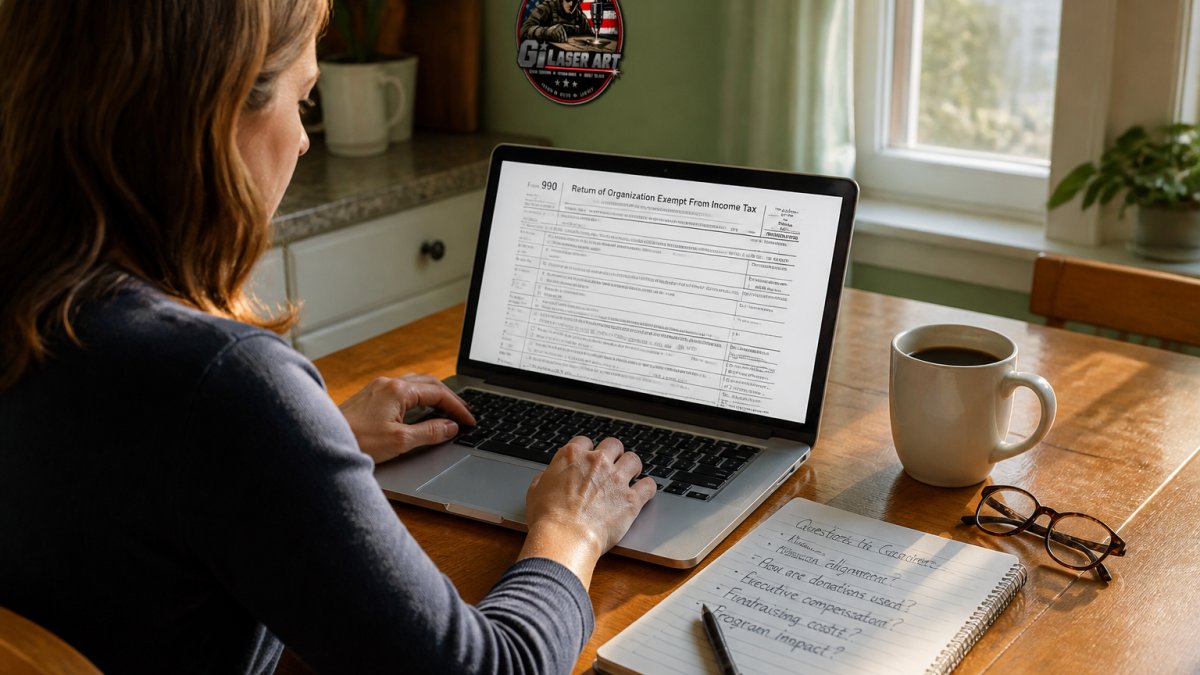
Most charities file one of three versions:
| Form | Who Files It | What It Shows |
|---|---|---|
| Form 990 | Larger nonprofits | Full financials, governance, programs |
| Form 990-EZ | Smaller nonprofits | Short version of key figures |
| Form 990-N | Very small nonprofits | Basic confirmation only |
Start with Part I, the summary page: total revenue, total expenses, and the change in net assets.
Then move to Part VIII (revenue) and Part IX (expenses). Separate contributions and grants from program service revenue and investment income; a group depending almost entirely on one grant or fundraiser is fragile.
Part IX also breaks out specific line items. Look at grants to other organizations, professional fundraising fees, and advertising.
Part VII lists officers, directors, and highest-compensated employees with reported compensation. Read it for governance signals: Is there an independent board, or are officers also listed as family members or business partners elsewhere in the filing?
Part III is the program service accomplishments section, the charity's own description of what it did and how much it spent on each program. Compare the narrative to the dollar figures in Part IX.
Balance sheet items in Part X matter too. Look at cash, savings, and investments against total expenses. A charity holding many years of expenses in reserve while running fundraising appeals is making a choice you can evaluate.
Schedule A reports public support and the public support percentage. A charity that relies heavily on a small number of donors has concentration risk.
What most guides miss is that the 990 also lists board members and their relationships. The IRS Form 990 instructions and schedules explain each line if you want to go deeper.
Watch out: a 990 is a snapshot prepared for tax compliance, not an audited impact report. Numbers can be aggregated, estimates used, and program descriptions self-reported.
Check State Registration and Complaint Records
Most states require charities to register before soliciting donations. Checking that registration is a fast way to confirm a group is accountable to a state regulator, not just the IRS.
Look up the charity through your state's charity regulator or attorney general's office. You can usually confirm:
- Whether the charity is registered to solicit in your state
- When it last filed its registration renewal
- Any complaints or enforcement actions on record
A missing registration is not always a scam. Some groups fall under exemptions. But an active complaint history is a serious warning sign. State records are public, and regulators publish enforcement actions when they take a charity to court.
What Charity Ratings and Watchdogs Can and Cannot Tell You
Charity ratings and watchdogs give you a quick snapshot, but they are not the final word. Independent evaluators score groups on finances, accountability, and transparency. Those scores help you compare options fast.
Here is what they can tell you:
- Whether the charity shares its financials openly
- How it scores on governance and accountability
- Whether it meets basic reporting standards
And here is what they cannot tell you:
- Whether the programs actually work
- How much impact each dollar creates
- Whether the mission matches your values
The overhead ratio is the most misused number in giving. A charity with low overhead is not automatically effective, and one with higher overhead may run programs that change lives. Ratings reward paperwork, not outcomes. Use them as a starting filter, then dig into the 990 and the annual report yourself.
Questions to Ask a Charity Before Donating
The fastest way to test charity donation transparency is to ask direct questions and see how the organization responds. A transparent charity answers plainly. A defensive one dodges.
Ask these before you give:
- What share of my donation funds programs versus overhead?
- Can you send me your most recent Form 990 and annual report?
- Who sits on your board, and are they independent?
- How do you measure whether your programs work?
- What happens to a donation that is not spent this year?
- Can you show me a specific example of your impact?
Request the answers in writing. A group that cannot produce basic documents is telling you something. Also ask how donations are processed, since payment method matters. The FTC guidance on charity scams and giving warns that scammers often push gift cards, wire transfers, or cash, because those are hard to trace and reverse.
Watch out: pressure to give "right now" over the phone is a classic red flag. Real charities let you take your time.
Trace Your Donation From Payment to Program Outcome
Donation tracking means following your money from the moment you pay to the program it funds.
Follow this trail:
- Payment: Pay by card or check so you have a record. Avoid cash and gift cards.
- Receipt: Get a written acknowledgment showing the amount and date.
- Restriction: Note whether your gift is restricted to a specific program or goes to general funds.
- Reporting: Check the next annual report to see how program spending changed.
- Outcome: Look for stories or data showing what the program achieved.
The last step is the hardest and the most important. Ask the charity how it tracks results, not just spending. A group that can name a specific outcome, like how many service dogs it placed or how many families it served, is showing you real accountability.
Here is what each step should actually produce. The IRS guidance on charitable contribution substantiation explains the recordkeeping rules.
Restricted gifts are where transparency gets tested.
For reporting, do not rely on the annual report alone. Compare the program spending line in the charity's Form 990 across two or three years.
Outcome tracking is where most donors stop and most charities struggle. Ask three specific questions: What does the program count? How often is it measured? Who reviews the results? A charity that tracks placements, completions, or follow-up outcomes can usually describe its method in plain language.
A practical method is to make your gift traceable without making it burdensome. Give by card or check, keep the receipt, note the restriction in writing, and ask the charity to include your gift in its next program update.
Watch out: a charity that cannot explain how it tracks restricted gifts, or that reports outcomes only as anecdotes with no counts, is not necessarily acting in bad faith, but it is asking you to trust rather than verify. That is the opposite of transparency.
Confirm a Veteran-Owned Shop's Giving Claim Before You Buy
When a business says your purchase supports a cause, treat that claim like any other donation promise. Verify it. This is where charity donation transparency and shopping decisions meet.
Here is how to confirm any giving claim:
- Ask which organization receives the funds, by legal name
- Confirm that organization is a registered 501(c)(3)
- Ask what percentage of each purchase goes to the cause
- Request proof, such as a donation receipt or partner letter
If you want broader context on why these purchases matter and how to judge them, read our guide on the benefits of buying from veteran owned shops. It walks through what to look for before you spend.
A shop that names its partner charity and shows proof is being honest with you. One that keeps the details vague is not.
Checking a charity takes a few minutes and a few searches. It protects your money and puts it behind work you actually believe in. At Gi Laser Art, we believe a purchase should mean something, which is why every custom piece supports our mission to provide service dogs to fellow veterans. Each personalized keepsake is crafted with attention to detail, from custom slate coasters to engraved wooden signs, so your gift carries real purpose. Get started with Gi Laser Art and give a gift that gives back.
Frequently Asked Questions
How do I check whether a charity is a 501(c)(3)?
Use the IRS Tax Exempt Organization Search at apps.irs.gov/app/eos. Enter the organization's exact legal name or its Employer Identification Number. The listing shows whether the charity's tax-exempt status is active and whether it can receive tax-deductible gifts. Confirm the name and address match what appears on the donation page, since scammers sometimes use names close to a real charity. If the organization does not appear, ask for its EIN and check again before giving.
What financial documents should I review before donating?
Start with the Form 990, which most charities must file annually and which is public. Look at Part I for total revenue and expenses, Part III for program accomplishments, Part VII for officer compensation, and Schedule G if fundraising is a large share of spending. Pair the form with the charity's audited financial statements and annual report when available. Reading two or three years side by side shows whether program spending is growing with revenue or falling behind it.
Are charity rating websites reliable?
They are a useful starting point, not a verdict. Ratings from watchdogs such as Charity Navigator, Candid and BBB Wise Giving Alliance pull from public filings and apply their own scoring models, so a strong score reflects the metrics they measure, not proof that a specific program works. A low score can flag real problems or simply reflect a small charity with thin reporting. Use ratings to decide where to dig deeper, then confirm with the Form 990 and the charity's own outcome data.
What are warning signs that a charity may not be transparent?
Watch for a charity that will not share its EIN or tax-exempt letter, has no physical address, pressures you to give immediately by phone or gift card, or cannot explain what share of donations reaches its programs. A Form 990 that is years out of date, missing schedules or shows most spending on fundraising and management are also red flags. State charity regulators publish complaint records, so a quick check there can confirm or clear your concerns.
